
International Day of the World’s Indigenous Peoples
“In the old times, when people’s lives were so directly tied to the land, it was easy to know the world as gift. When fall came, the skits would darken with flocks of geese, honking “Here we are.” It reminds the people of the Creation story, when the geese came to save Skywoman. The people are hungry, winter is coming, and the geese fill the marshes with food. It is a gift and the people receive it with thanksgiving, love, and respect. But when the food does not come from a flock in the sky, when you don’t feel the warm feathers cool in your hand and know that a life has been given for yours, when there is no gratitude in return — that food may not satisfy. It may leave the spirit hungry while the belly is full. Something is broken when the food comes on a Styrofoam tray wrapped in slippery plastic, a carcass of a being whose only chance at life was a cramped cage. That is not a gift of life; it is a theft.
How, in our modern world, can we find our way to understand the earth as a gift again, to make our relations with the world sacred again? I know we cannot all become hunter-gatherers — the living world could not bear our weight — but even in a market economy, can we behave “as if” the living world were a gift?
We could start by listening to Wally. There are those who will try to sell the gifts, but, as Wally says of sweetgrass for sale, “Don’t buy it.”Refusal to participate is a moral choke. Water is a gift for all, not meant to be bought and sold. Don’t buy it. When food has been wrenched from the earth, depleting the soil and poisoning our relatives in the name of higher yields, don’t buy it.
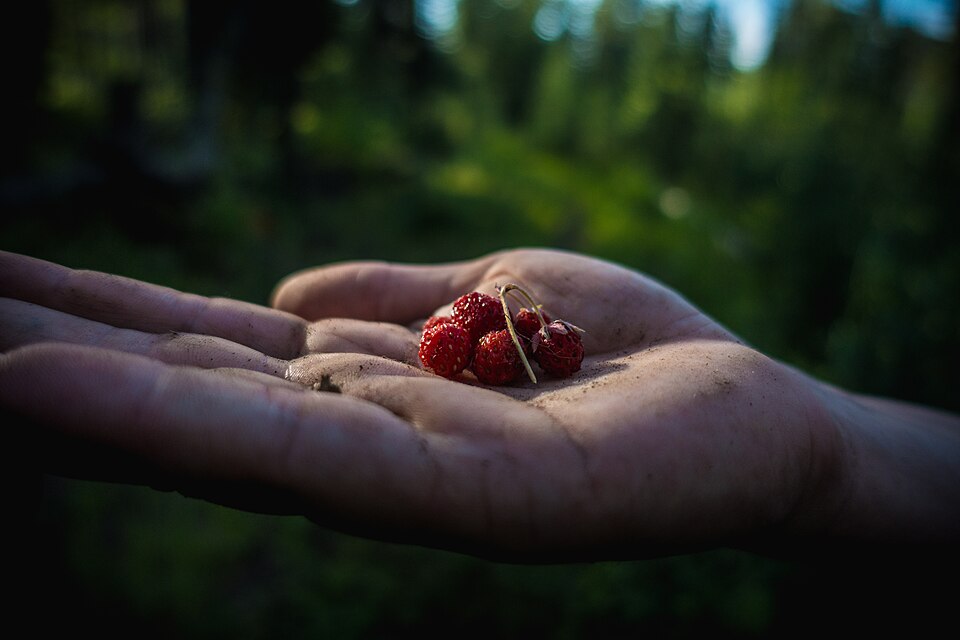
In material fact, [wild] Strawberries belong only to themselves. The exchange relationships we choose determine whether we share them as a common gift or sell them as a private commodity. A great deal rests on that choice. For the greater part of human history, and in places in the world today, common resources were the rule. But some invented a different story, a social construct in which everything is a commodity to be bought and sold. The market economy story has spread like wildfire, with uneven results for human well-being and devastation for the natural world. But it is just a story we have told ourselves and we are free to tell another, to reclaim the old one.
One of these stories sustains the living systems on which we depend. One of these stories opens the way to living in gratitude and amazement at the richness and generosity of the world. One of these stories asks us to bestow our own gifts in kind, to celebrate our kinship with the world. We can choose. If all the world is a commodity, how poor we grow. When all the world is a gift in motion, how wealthy we become.”
From Braiding Sweetgrass by Robin Wall Kimmerer, Professor of Environmental Biology and enrolled member of the Citizen Potawatomi Nation
 Chorlton Unitarians