Thought for the day, Sunday 7th July

“Only the transitory lends itself to description; but what we feel, surmise but will never reach (or know here as an actual happening), the intransitory behind all appearance, is indescribable. That which draws us by its mystic force, what every created thing, perhaps even the very stones, feels with absolute certainty as the centre of its being, what Goethe here — again employing an image — calls the eternal feminine — that is to say, the resting-place, the goal, in opposition to the striving and struggling toward the goal (the eternal masculine) — you are quite right in calling the force of love. There are infinite representations and names for it . . “

From the letters of Gustav Mahler (1860 – 1911), born on this day

Thought for the day, Saturday 6th July

“Sometimes we feel that we aren’t in our true home because the person we love isn’t there. We think that if we can be together with our beloved, we’ll feel more at home. But if we have not found our true home, then even when we’re with the person we love, we won’t feel at home. This is why it’s very important for us to find our true home first. Only then can we help our beloved one find their true home. Otherwise, both of us will be without a home, still looking somewhere outside of ourselves.

We should not think that our true home is wherever our beloved one is. Our true home is in our heart. And when we have found our true home, we feel at home anywhere we go.”

From Peace Is This Moment by Thich Nhat Hanh

Thought for the day, Friday 5th July

“You are a part of me I do not yet know: What do these words mean to you? I practice saying these words in my mind when I see faces on the street, on the screen, across the table. I practice with people I fear or want to hate. I practice with parts of the earth, with trees and birds, rocks and mountains. I say these words to parts of my own self — my grief or pain, my rage or fear. And every time, these words cultivate a sense of humility in me, an openness. An ability to get quiet and listen. I learn something new. I gain information for how to respond with care. I make wonder a practice. Wonder is the precondition to love. It is what makes love revolutionary.”

Valarie Kaur

Thought for the day, Thursday 4th July

“”Three indispensables of a nobleman are: his harp, his blanket and his cauldron.” – triad from Laws of Hywel Dda

Under most modern laws of distraint – whereby goods are removed from a household in compensation for debts unpaid – there are certain articles that cannot be removed. These usually include the items by which the householder earns her living, the tools of a worker’s trade, the bed, and the means to make food. In the triad above, from the Welsh legal code formulated by King Hywel Dda in the ninth century, we discover that the three indispensable objects of the nobleman are the harp by which his bard entertained him, the blanket that kept his body warm in bed, and the cauldron that heated his food. Today, these items would probably be equivalent to the television set, the bed, and the stove: means of entertainment, sleep, and food.

We have become used to the possession of certain inalienable rights: life, liberty, the pursuit of happiness, among others, in our modern world. These are rights that we take for granted, that are enshrined in constitutions and maintained by the law of the land; and yet even within civilized societies there are many who do not enjoy these rights. The poor, the disadvantaged, and others who live on the margins of society need the actions and voices of those who honour the commitment to the inalienable rights that we should all enjoy.”

From The Celtic Spirit: Daily Meditations for the Turning Year by Caitlin Matthews

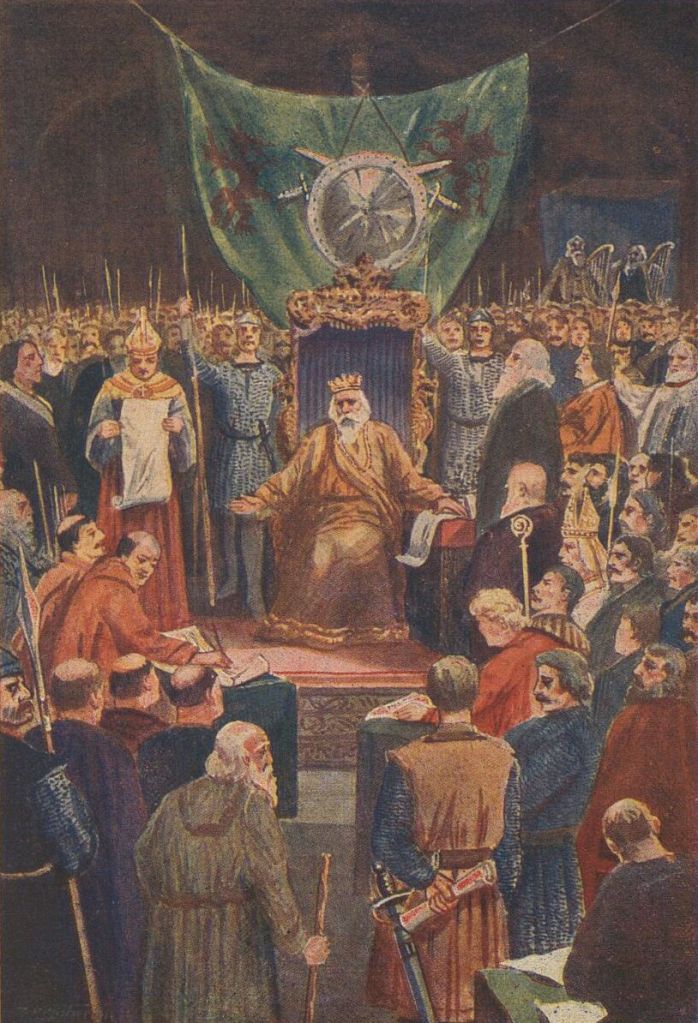
Illustration ‘Proclaiming the laws of Hywel Dda’ from Flamebearers of Welsh History

Thought for the day, Tuesday 2nd July

“We must become so alone, so utterly alone, that we withdraw into our innermost self. It is a way of bitter suffering. But then our solitude is overcome, we are no longer alone, for we find that our innermost self is the spirit, that it is God, the indivisible. And suddenly we find ourselves in the midst of the world, yet undisturbed by its multiplicity, for our innermost soul we know ourselves to be one with all being.”

Hermann Hesse (1877 – 1962), born on this day

Thought for the day, Monday 1st July

“”Whatever anyone does or says, for my part I’m bound to the good. In the same way an emerald or gold or purple might always proclaim: ‘whatever anyone does or says, I must be what I am and show my true colours.’” Marcus Aurelius, Meditations, 7.15

The Stoics believed that every person, animal, and thing has a purpose or a place in nature. Even in ancient Greek and Roman times, they vaguely understood that the world was composed of millions of tiny atoms. It was this idea – this sense of an interconnected cosmos – that underpinned their sense that every person and every action was part of a larger system. Everyone had a job – a specific duty. Even people who did bad things – they were doing their job of being evil because evil is a part of life.

The most critical part of this system was the belief that you, the student who has sought out Stoicism, have the most important job: to be good! To be wise. “To remain the person that philosophy wished to make us.”

Do your job today. Whatever happens, whatever other people’s jobs happen to be, do yours. Be good.”

From The Daily Stoic by Ryan Holiday and Stephen Hanselman

Thought for the day, Saturday 29th June

“Most of us lead far more meaningful lives than we know. Often finding meaning is not about doing things differently; it is about seeing familiar things in new ways. When we find new eyes, the unsuspected blessing in work we have done for many years may take us completely by surprise. We can see life in many ways: with the eye, with the mind, with the intuition. But perhaps it is only those who speak the language of meaning, who have remembered how to see with the heart, that life is ever deeply known or served.”

Rachel Naomi Remen